
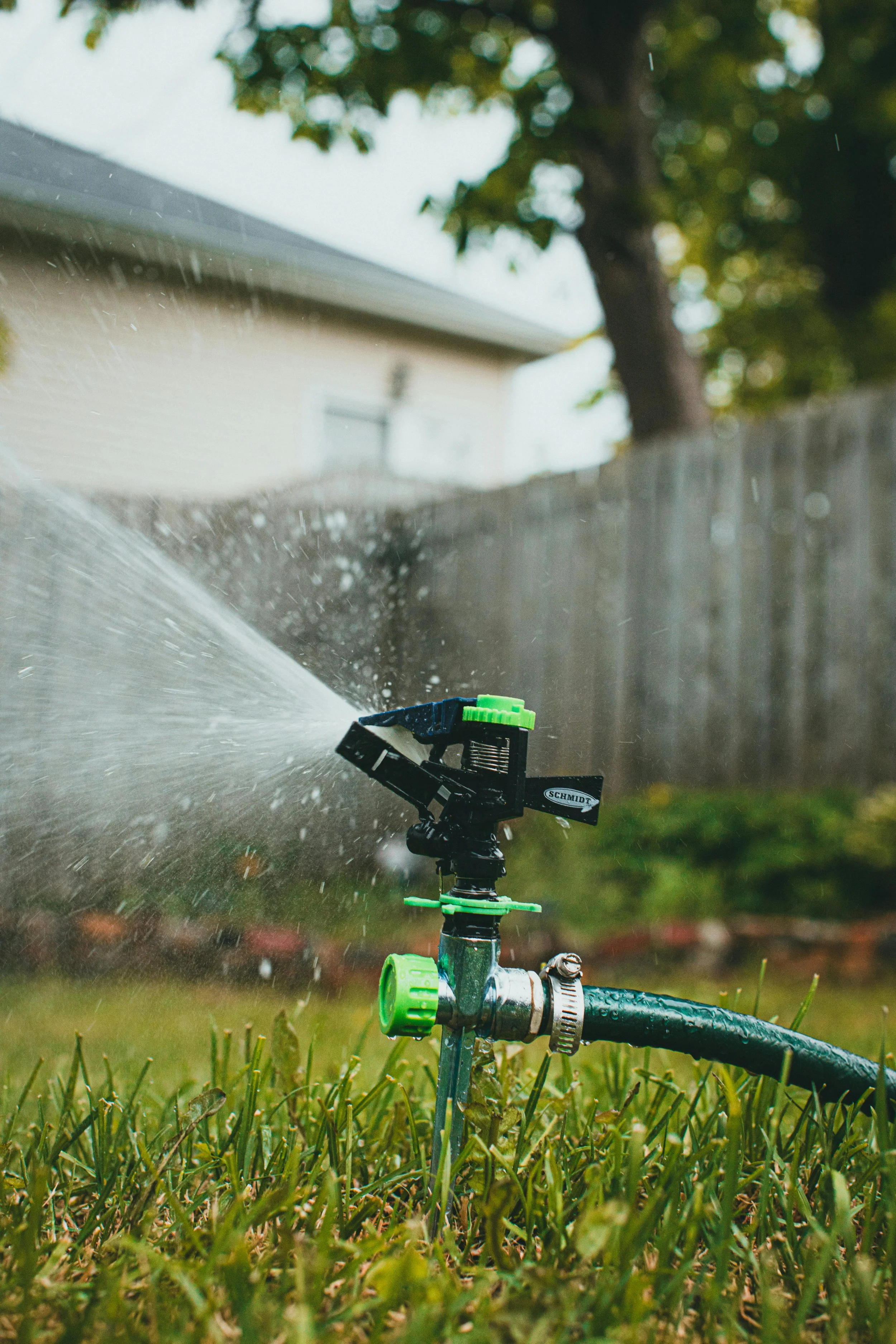
Wildfire defense is a category problem before it is a product problem. A growing number of Western homeowners are buying water-based rooftop sprinkler kits to defend against wildland fire — and watching that strategy fail in ways the brochure never warned them about. This article explains why the water-spray approach is the wrong tool for the threat, and what a proactive, EPA Safer Choice, phosphate-free fire inhibitor system replaces it with.
Do wildland firefighters use lawn sprinklers to fight wildfires?
No. Wildland firefighters do not use lawn sprinklers to fight wildfires. They cut fuel breaks, remove combustible vegetation, set backburns, and apply long-term retardants ahead of the flame front. Their work is proactive — designed to interrupt the fire's path before it arrives, not to chase it once it does.
That distinction matters because it reframes the entire homeowner question. The professionals dealing with wildland fire every fire season have already concluded that water at the structure is a losing strategy. They commit their water capacity to the engines, the hand crews, and the structure protection groups embedded with the firefight — not to a yard sprinkler bolted to a roof. If the people doing this for a living don't trust water as the primary defense, neither should a homeowner.
Why do rooftop water sprinkler systems fail to stop wildfires?
Rooftop water sprinkler systems fail to stop wildfires because they collide with physics. A flame front in a wind-driven wildfire generates radiant heat that can exceed 1,000°F at the structure surface, while relative humidity drops into the single digits. Water droplets evaporate in flight before they reach combustible siding, eaves, or decking.
The full failure mode is more than evaporation. Wildland-Urban Interface (WUI) fires push their own wind, which carries water spray off target by tens of feet. Embers — the cause of the majority of home ignitions in WUI events per NIST research[1] — slip through the moisture envelope and lodge in dry needle beds, gutter debris, and vent openings smaller than a millimeter. The sprinkler is wetting the wrong surfaces, at the wrong time, with the wrong physics.
For homeowners who want the short list of why water-at-the-structure underperforms in a real WUI event, the failure points are well established:
- Radiant heat exceeds water's evaporation threshold. Wildfire radiant heat at the structure can run past 1,000°F. Water droplets boil and disperse before they bond to the surface they were meant to protect.
- Wind-driven embers bypass the moisture envelope. Per NIST Wildland-Urban Interface Fire Group research, embers cause the majority of WUI home ignitions. A water curtain doesn't stop them; it briefly delays the surfaces they need to dry out.
- Municipal water grids lose pressure or are cut. During major fires, hydrant draw spikes, public water pressure collapses, and utilities cut power, which kills any pump that depends on the grid.
- Plumbing systems are mechanical failure stacks. Pumps, valves, controllers, freeze-protect circuits, and supply lines each have their own failure mode. A single point of failure stops the whole system.
- Reservoirs are finite. A residential water reservoir of typical size empties in minutes under sustained spray, long before the fire front passes.
The list isn't a list of inconveniences. It's a list of structural reasons the strategy is the wrong category for the threat.
Does municipal water pressure hold up during a wildfire?
No. Municipal water pressure does not hold up during a major wildfire. As fire agencies draw heavily from hydrants and utilities preemptively cut power to reduce ignition risk, residential water pressure drops sharply or fails entirely. Any defense plan that depends on the grid loses its supply at the exact moment it is needed most.
This is documented behavior, not a worst-case scenario. The 2017 Tubbs Fire, the 2018 Camp Fire, the 2021 Marshall Fire, and multiple Montana and California events since have all produced documented water-pressure collapse in the affected service area.[2] Homeowners running rooftop sprinklers hooked into municipal supply in those events watched their systems run for minutes, then trickle, then stop.
Independent water sources — wells, tanks, pools — only partially mitigate the problem. Residential wells were never engineered for the gallons-per-minute output a serious wet-down requires. Tanks empty. Pool pumps depend on power. Each of those is just another mechanical failure point added to the stack.
Can a permanent fire inhibitor protect a home better than water?
Yes. A permanent fire inhibitor protects a home better than water because it does the protective work proactively, before the fire arrives — and it does not depend on power, pressure, supply volume, or wind direction at the moment of the event. CitroTech, the only EPA Safer Choice–recognized long-term fire inhibitor in the U.S., remains effective for months until heavy rainfall removes it.[3]
The reason a fire inhibitor outperforms reactive water is mechanical. When applied to vegetation, cellulosic siding, decking, and structural wood, CitroTech modifies the cellulose structure at the surface, slows ignition kinetics, accelerates protective char formation, and exhibits intumescent properties that interrupt combustion before sustained flaming can take hold. The treated surface is engineered not to ignite — rather than being rinsed in water that will evaporate before it does any work.
The result is a measurable shift in the homeowner's risk profile:
| Defense Strategy | Active When Fire Arrives? | Depends on Power? | Depends on Water Grid? | Depends on Homeowner Present? | Protects Against Ember Ignition? |
|---|---|---|---|---|---|
| Water-based rooftop sprinkler kit | Only if all dependencies hold | Yes | Often yes | Often yes | Limited (water evaporates) |
| Garden hose / pump-and-tank reactive defense | Only if pressure and supply hold | Yes (pump) | Yes (well or grid) | Yes | No |
| Permanent CitroTech fire inhibitor system | Already in place | No | No | No | Yes (treats ignition surfaces) |
| Home hardening (Class A roof, ember-resistant vents, defensible space) | Already in place | No | No | No | Yes (eliminates ignition paths) |
| CitroTech + home hardening combined | Already in place | No | No | No | Yes — layered defense |
Pre-treatment is not a substitute for home hardening. It is the chemistry layer that sits on top of a hardened structure to deal with the embers and surfaces home hardening alone can't fully control. Together they're the configuration insurers and underwriters increasingly want to see in a wildfire-exposed file.
What is a Big Sky Fire Defense CitroTech wildfire defense system?
A Big Sky Fire Defense CitroTech wildfire defense system is a permanently installed, closed-loop application system that coats vegetation, cellulosic siding, decking, and structural wood with CitroTech, a non-toxic, phosphate-free, EPA Safer Choice and UL Greenguard Gold–certified long-term fire inhibitor.[3][4] The system is engineered around proactive coverage, not reactive water spray.
A typical residential installation includes:
- A site assessment built against WUI standards including NFPA 1144 (Standard for Reducing Structure Ignition Hazards from Wildland Fire), California Building Code Chapter 7A, and the International Wildland-Urban Interface Code (IWUIC).[5]
- A perimeter, roof-mounted, or combined sprinkler layout customized to the property's ignition geometry — eaves, decks, fence connections, vegetation, and ember trap zones.
- A self-contained tank and pump operating independently of the municipal grid or well.
- Application of CitroTech, which delivers ASTM E84 Class A fire-rated performance on treated materials and resists radiant heat thresholds up to 1,000°F at the surface.[6]
- CitroTech remains effective on treated surfaces for up to three months, until heavy rainfall naturally washes it away — supported by photographs, certifications, and a complete documentation packet for the homeowner's insurance file, with reapplication scheduled around fire season and weather.
The defense is in place before fire season starts. It does not depend on power, pressure, supply, or the homeowner being on site. When embers begin landing — which, per NIST, is how the majority of WUI homes are actually lost — the surfaces they need are already engineered against ignition.
How can Montana homeowners reduce wildfire insurance risk with a fire inhibitor system?
Montana homeowners reduce wildfire insurance risk by combining documented mitigation work — home hardening, defensible space, and a permanent fire inhibitor system — with the documentation packet carriers and underwriters need to credit the work. Under Montana HB 136, insurers can offer premium reductions for verified wildfire mitigation. Under HB 533, homeowners can request disclosure of any wildfire risk score used against them.[7][8]
The combination matters. HB 136 opens the door for credits. HB 533 opens the door for appeals. Neither door does anything without verifiable, dated, certified mitigation work behind it. Every Big Sky Fire Defense install ships with an insurance-grade documentation packet: site assessment, system specifications, EPA Safer Choice and UL Greenguard Gold certifications, ASTM E84 reference, install dates, before-and-after photographs, and a maintenance schedule. That is the file your independent agent walks into the carrier with.
If you are evaluating a rooftop water sprinkler kit, or have been told by a neighbor it's the right move, get a second opinion before you spend the money.
Get Protected NowBig Sky Fire Defense offers free site evaluations across Montana. We will walk the property, identify the actual ignition paths on your structure, and tell you straight what the right configuration looks like for your layout. Visit bigskyfiredefense.com or call 406-422-2716.